MUMTAZ

Rodent Control in Dubai, Sharjah & Abu Dhabi

Overview

Rats and mice contaminate food, gnaw through electrical wiring and packaging, and carry disease, making rodent control a priority for villas, warehouses, restaurants, and logistics facilities alike. Rodent activity tends to spike in cooler months as rodents seek shelter indoors, and a small population can grow quickly if entry points and food sources aren't addressed.

MUMTAZ's rodent control programs combine exclusion (identifying and sealing entry points), tamper-resistant bait stations placed along runways and entry routes, and monitoring to track activity over time. For warehouses and commercial sites we map bait station locations and provide a digital log for each visit, supporting HACCP and food safety audits, a service line trusted by clients including Nesto Hypermarket and Ocean Oilfield.

Exclusion first, because bait alone is a treadmill

A building with an open route in will keep receiving rodents no matter how much bait sits in it. Killing the ones inside empties the space, and the space refills from the same route, which is why a site on permanent baiting with no proofing is paying a subscription rather than solving a problem.

So the survey looks for the way in before it looks for a station. A young mouse passes a gap the width of a pencil and a rat a gap the width of a thumb, so the candidates are door sweeps, service penetrations, weep holes, damaged drain covers, roof junctions and the gap where a shutter meets an uneven floor. Where the fix is a building work rather than a pest work, the report says so.
Reading the signs before choosing the method

Droppings tell you species and roughly how recent. Smear marks along a wall or a pipe show a route used repeatedly, because rodents travel the same edges. Gnawing on packaging, cable insulation or door edges shows what they are working on. Nesting material in a void, and the sound of movement at a consistent time of night, narrow it further.

Those signs decide placement, and placement decides whether anything works. Stations put along an actual runway are visited; stations put where they are convenient for the technician are not, and a site can carry twenty untouched stations and a live population at the same time.

Stations, monitoring and the record

Tamper-resistant stations are placed along runways and entry routes, numbered, and mapped. Each visit records what each station shows, so activity can be read as a trend across the site rather than as an anecdote, and a station that keeps showing activity points at a specific defect rather than at a need for more bait.

For audited sites that map and its visit history are the deliverable as much as the control is. An auditor is assessing whether the site is managed, and a numbered device plan with a dated history answers that in a way a receipt does not.

Housekeeping, and the things that keep a site attractive

Food and shelter keep a population fed after the route is closed. Spilled product under racking, waste held too long or in damaged bins, pallets and stored cardboard against a wall, and vegetation touching the building all sustain activity that proofing alone will not end.

None of that is a criticism of a site; it is the practical list, and it is cheaper to act on than to treat around. Where we find it we name it in the report, because a programme that quietly absorbs a housekeeping problem year after year is a programme that never finishes.

What you can do between visits

Three habits move the needle more than extra bait. Keep waste in closed bins and get it off site on schedule, because an overflowing bin is a food supply the programme is competing with. Keep stock and pallets off the wall so there is no covered runway along the perimeter, and so a technician can actually see the floor edge.

And report sightings with the detail: where, what time, and how big. A sighting at the same spot each evening is a route we can place against; a sighting reported as "somewhere in the warehouse" a week later is not. The visit history is more useful when the site fills in what happened between visits.

This is one of the programmes run by our pest control in Sharjah division.

How it works

Rodent Control, step by step

  1. 01

    Inspection

    Identify droppings, gnaw marks, runways and entry points.

  2. 02

    Monitoring

    Bait stations and tracking patches placed along identified routes.

  3. 03

    Targeted Treatment

    Tamper-resistant baiting and trapping appropriate to the site.

  4. 04

    Documentation

    Digital bait station maps and visit logs for audits.

  5. 05

    Prevention

    Exclusion work to seal entry points and reduce future activity.

Scope

Rodent Control, what is included

Included in the scope

  • Survey for entry routes, runways, harbourage and the signs that show which species
  • Tamper-resistant bait stations placed along actual runways, numbered and mapped
  • Monitoring with each station recorded at every visit
  • Interior and exterior treatment as the survey indicates
  • A device map and a visit history, available by link
  • Named findings where proofing, housekeeping or waste handling is sustaining activity

Quoted separately

  • Proofing and building works: door sweeps, mesh, sealing penetrations and drain repairs, quoted separately
  • Removal of carcasses from inaccessible voids requiring opening up
  • Waste management contracts and bin replacement
  • Landscaping and vegetation clearance identified as harbourage
  • Deep cleaning of contaminated areas, which is a separate service
  • Any guarantee that a building open to deliveries will stay free of rodents

Compliance & Certification

Municipality-approved products in tamper-resistant stations
placed by trained technicians.
Numbered device plan and dated visit history
written for audit rather than produced on request afterwards.
ISO 45001:2018 occupational health and safety.
ISO 14001:2015 environmental management for product selection and disposal.
A technical service report after every visit
including an IPM assessment.

Where we work

Rodent Control, where we do it

  • WarehousesShutter lines, goods-in and racking voids, with an external ring.
  • Restaurants & KitchensWaste routes, drains and the gap behind the line.
  • Residential BuildingsBin rooms, risers and basement car parks.
  • VillasGarden boundaries, roof junctions and service penetrations.
  • RetailStock rooms and shared service corridors.
  • Labour AccommodationKitchens, waste areas and the building perimeter.

Rodent Control, where the work comes from

The districts this work comes from most. Serving clients across the UAE from offices in Sharjah, Dubai and Abu Dhabi.

Dedicated MUMTAZ teams cover Al Zahia and Aljada in Sharjah, and JVC, JLT and JVT in Dubai. Elsewhere the job is assigned from the nearest of our three offices.

The difference

Why MUMTAZ

  • Tamper-resistant, child- and pet-safe bait stations

  • Digital bait station mapping and visit logs

  • Supports HACCP and food safety audit requirements

  • Exclusion work to seal entry points permanently

Get a quote

Request a Quote

FAQ

Frequently Asked Questions

Look for droppings, gnaw marks on packaging or wiring, grease marks along walls, and scratching sounds at night.

Yes, we use tamper-resistant, lockable bait stations designed to keep contents inaccessible.

Initial activity reduction is often visible within 1-2 weeks, with full control typically achieved within 4-6 weeks alongside exclusion work.

Yes, we provide digital bait station maps and visit logs suitable for HACCP and client audits.

Sealing entry points combined with ongoing monitoring is the most effective long-term strategy and is included in our AMC programs.

Yes. Card on site at the time of service on our technicians' terminals, by payment link, Apple Pay, Google Pay, bank transfer or cheque. Payment is taken on completion of one-off work, and on the agreed schedule for annual contracts. Every price we publish is incl. VAT.

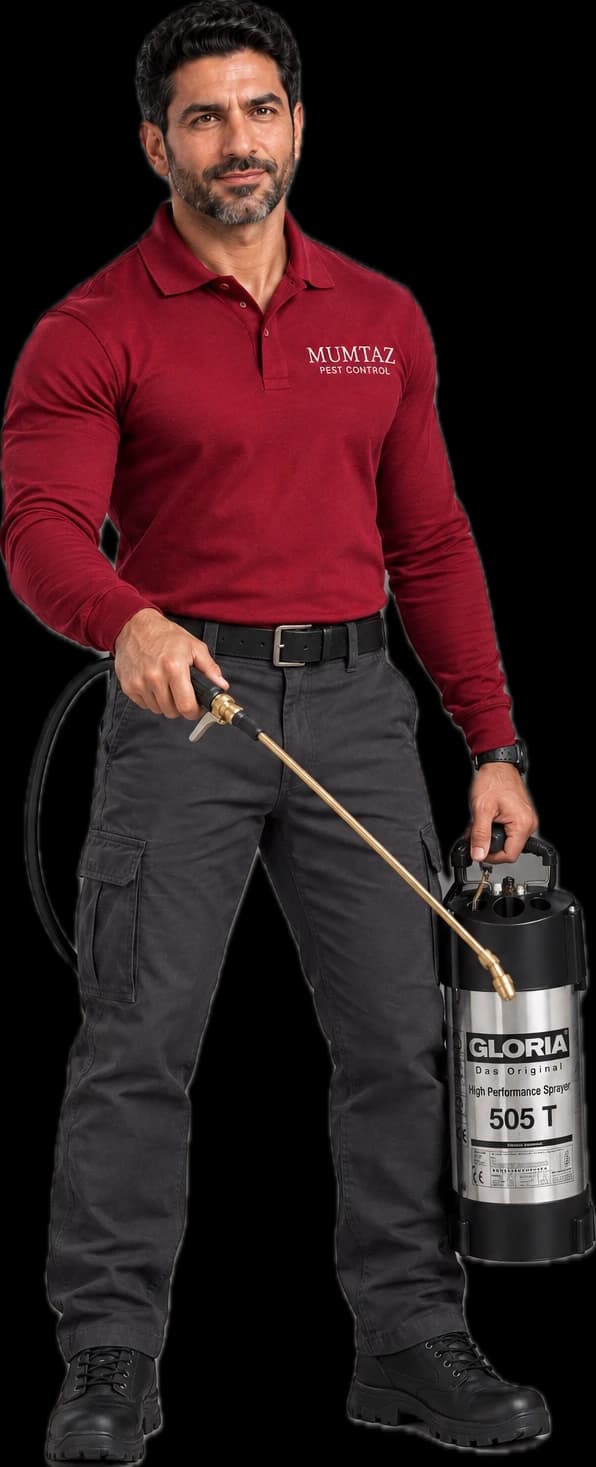
Pest control technician in the red MUMTAZ Pest Control uniform holding a compression sprayer, full-length cut-out
A MUMTAZ Pest Control technician in the red uniform, carrying a compression sprayer.

Every job starts with an inspection, the treatment is chosen for what the inspection found, a follow-up visit is scheduled, and you receive a written service report. How we treat, and what happens after the visit

You may also need

CallWhatsAppGet Quote